
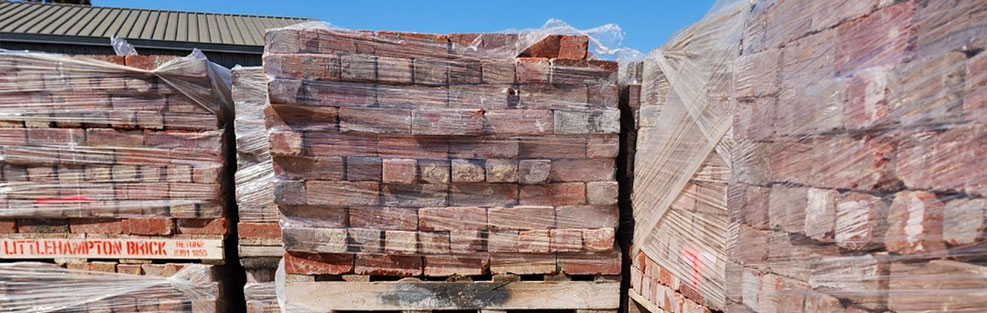
Ask a bricklayer about mud bricks, and you usually get a pause before the answer. They are not difficult in the way a tricky course of clinkers is difficult. They are difficult because there are not many left, and the ones that survive have already spent decades holding up a building they were never engineered to hold up.
That is the honest starting point. If you want mud brick in a wall, you are not really shopping. You are waiting for the right batch to come off a site.
Why they are so hard to get hold of
Mud bricks were never made in a factory. Someone mixed soil, water and straw by hand, pressed it into a mould, and left it in the sun. No kiln. No consistency. No pallets. So when a building comes down, the bricks come down with it, and a fair share of them do not survive the trip.
Our salvage team pulls them from architectural and demolition sites, rural properties and heritage organisations across the state. Some jobs give up a few hundred usable bricks. Others give up a stack of crumbled corners and nothing worth loading onto a truck. Most of the bricks recycled Melbourne-wide come off standard demolition work, but mud brick recovery is slower and far more selective than that. It has to be. They are fragile, and once one breaks, that is the end of it.
That scarcity is also why we will not promise a quantity we cannot deliver. Ring us with a number and a timeline, and we will tell you straight whether it is realistic this month or not.
What is actually in one
A traditional mud brick is a mix of sand, silt, clay and water. Straw goes in for reinforcement, and in older examples, animal dung as well. Then it dries in the sun rather than in a kiln, which is why the energy cost of making one is close to nothing next to fired brick.
The result behaves differently from anything else on a modern site.
The colour sits in the reddish and brown range, with a rough, uneven face. No two are identical, and that is the point.
They are light. You notice it the moment you pick one up, and it changes how you plan the handling.
They breathe. Moisture evaporates out of the wall rather than getting trapped inside it, which cuts condensation.
They insulate well. Interiors stay noticeably cooler through a Melbourne summer without much help from anything else.
And they are soft. Low compressive strength, which is the single most important thing to understand before you design anything around them.
The water problem, stated plainly
Mud brick is not water resistant. It never was. These were built for dry climates, and rain will work away at an unprotected face over time.
That does not rule them out. It rules out certain uses, and it means any exposed application needs a protective coating and sensible detailing. Decent eaves. A capping on a freestanding wall. Drainage that keeps water away from the base. Plenty of people skip all three and then blame the brick.
If a supplier tells you a mud brick wall needs no protection outdoors, ignore the advice and probably the supplier too.
Where they earn their place
The old mud bricks Melbourne renovators come looking for tend to end up in one of a handful of places.
Heritage restoration is the obvious one. If you are rebuilding a section of vernacular architecture or repairing a courtyard wall, matching the original material matters more here than anywhere else on the job.
Interiors are the fastest-growing use we see. One mud brick feature wall in a living room does something a rendered finish cannot fake, and indoors the water issue disappears entirely.
Low boundary and garden walls suit them well, provided they are capped and sited with a bit of thought.
Community and cultural buildings use them for the same reason they always have. The material carries meaning, and local groups often want a structure built from something with history already in it.
We also get straightforward energy-efficiency projects, where the thermal performance is the whole reason for the choice and the rustic look is a bonus.
What to check before you commit
Ask where the batch came from. A supplier who cannot tell you the source is guessing.
Ask about size consistency. Handmade bricks vary, and your bricklayer needs to know how much variance they are dealing with before they quote you.
Ask about condition. Chipped edges are normal and often exactly what people want. Soft, crumbling faces are not.
And get your builder to handle the actual bricks rather than looking at photos. Ten minutes with a sample tells them more than any spec sheet will.
Common questions
- Are they weather resistant?
No. They keep interiors cool and perform well in dry conditions, but they need protection from rain and standing water. - Can I use them in a modern home?
Yes, and it is one of the better uses for them. The rough, earthy face sits well against clean modern finishes, and you are reusing material instead of firing new. - Do you offer bulk pricing?
Call 1300 893 366, and we will talk it through. Pricing on salvaged stock depends on what has come in that month, so it is a conversation rather than a fixed list.
Coming to look at them
We hold recycled and refurbished mud brick alongside the rest of the range, including clinker, cream, Hawthorn, fire, masonry, paving, solid clay, vent and wirecut brick. The yard is at 33-35 Brooklyn Court, Campbellfield, open Monday to Friday, 9 am to 5 pm.
Come and look at them before you decide anything. Mud brick is one of those materials that reads badly in a photograph and makes complete sense the moment it is in your hand.
Call 1300 893 366 or get a free quote.