
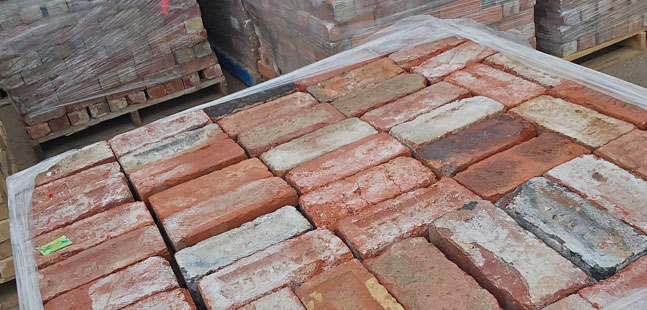
Specifying reclaimed brick on your own place is one thing, but specifying it on a client’s job is a different proposition entirely, because you are the one carrying the programme, the variation risk and the phone call when the second delivery does not match the first. This is the version of that conversation written for people who do it for a living.
Spec the brick to the job, not the photograph
Most sourcing problems begin at this point. Somebody picks a look from a mood board, and the material underneath turns out to be wrong for what it is being asked to do on site.
Reclaimed brick is not a single product, and the types behave differently enough that substituting one for another halfway through a job will cost you real money.
Wirecut is what you reach for when you need predictability. It was made by drawing a tensioned wire through moist clay and firing the result, which is why the edges come out clean and sharp, and the shape stays uniform across a batch. You get vertical and horizontal striations from the wire, a smooth face, weather resistance and strong compressive performance, and many of them carry cores or holes that keep the weight down while giving the mortar something to key into. Recycled wirecut clay bricks come up in cream, grey, brown and red, which makes them the sensible specification for mid-century restoration, driveways, courtyards and boundary walls where consistency in the laying matters more than character.
Hawthorn is the heritage match, made from local Hawthorn clay and kiln-fired, showing purple, brown and deep red skin with black flecking through it. Specify it for restoration work and heritage-style facades, and plan to sort by quality and size rather than assuming uniformity across the palette.
Clinker sits at the opposite end of the scale, and deliberately so. These were originally overfired factory rejects, which is exactly why they came out distorted, vitrified, dense and dark, with no two the same and no consistent sizing to work from. Specify it only where that irregularity is the design intent rather than something your bricklayer has to work around.
Fire brick belongs anywhere heat is involved, since its refractory composition holds up past 1000°C with good thermal shock resistance, which covers fireplaces, pizza ovens, chimneys and smokers.
Paving handles the traffic, being flat, hard, slip-resistant and capable of taking vehicle weight across a driveway.
The recycled red bricks Melbourne hospitality fitouts run on turn up constantly in boutiques, cafes and venue floors, generally where the client wants the building to look as though it predates the lease.
Check the yard rather than the catalogue
The largest single difference between sourcing new and sourcing reclaimed is that the stock is finite and batch-dependent, since what exists is whatever came off recent demolition work rather than whatever the factory ran last week.
Confirm what is physically in the yard before you commit to dates, and by that I mean what is stacked, cleaned and ready to load this week rather than what appears on a page. For anything unusual or heritage-specific, that conversation needs to happen early in the programme instead of the week your bricklayer is due to start.
Go and pick the batch yourself
You can select your own stock at the Campbellfield yard, and on a job of any size it is worth the trip. Ten minutes with the pallets will tell you what no listing ever will: how much size variation is actually sitting in there, whether the colour range works against the rest of your material schedule, and whether the faces hold up as well as the sample suggested.
Take your bricklayer along if the job warrants it, because a layer who has handled the actual brick before quoting will price it accurately, while a layer working from photographs will price defensively and you will wear the difference.
What belongs in the order
Four things are worth confirming in writing rather than assuming, and none of them take long to nail down.
The first is quantity, which should include your breakage allowance rather than sitting at whatever your bare calculation produced, since salvaged supply rarely lets you top up later with matching stock. The second is condition on delivery, meaning whether the mortar, paint and dust have been removed, whether an inspection team has checked for wear and cracks, and whether the load arrives sorted and stacked on pallets ready to lay. Stock that turns up finished saves you trade hours that never show up anywhere in the unit price.
The third is delivery access, covering truck access, where the pallets can physically land and how far the material then has to travel across the site. The fourth is lead time with an actual date attached to it.
Structural work needs a proper conversation
If reclaimed brick is going into anything load-bearing rather than decorative, raise it with both the supplier and your engineer before you place the order. Masonry and clinker stock does get used structurally, and the bonding patterns are the ones your bricklayer already works with, whether that is English, Flemish or running bond. Structural specification on a client job is still not something to settle from a product page, so get the condition of the actual batch confirmed and get whatever sign-off you need on paper.
The same principle applies to mortar and pointing against old brick, which is a discussion to have with your layer before the quote rather than a decision anyone makes on the morning of the pour.
Manage the client’s expectations before laying starts
This is where jobs come unstuck socially rather than technically. The variation in reclaimed brick is the product itself, covering colour range, weathered faces and size differences across a batch, and clients who chose it from one photograph sometimes do not grasp that until a wall is half built.
Build a sample panel, get it looked at and signed off, and agree how the brick will be blended across pallets so the variation reads as deliberate rather than patchy.
Buy local for the unglamorous reason
Sourcing locally cuts transport cost, and it cuts lead time, and on a job that is already running, the second of those is usually worth more to you than the freight saving. It also means you can get to the yard and look at something in the same week rather than making decisions from photographs sent by someone in another state.
Confirm the stock exists, see it before you buy it, order the full quantity plus allowance in one go, get condition on delivery in writing, and put up a sample panel before the client sees a wall. Do all five and reclaimed brick is a straightforward material to build with.
The yard is at 33-35 Brooklyn Court, Campbellfield, open Monday to Friday, 9 am to 5 pm. Call 1300 893 366 or get a free quote with your quantities and dates.