
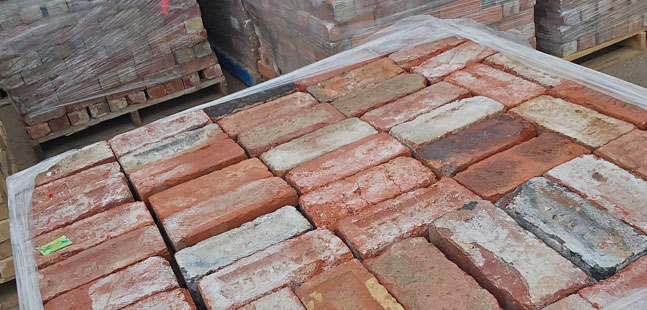
From ten metres away, a yard full of reclaimed bricks looks like one thing. Red, rectangular, stacked on pallets. Get close, and the differences start to matter — especially if you’re the one laying them on a Saturday.
Paving bricks and clinker bricks are the clearest example. Both are salvaged. Both are cheaper than new. Both come out of Bricks Victoria’s yard in Campbellfield. But they were made for opposite reasons, and they behave differently once they’re in the ground or in the wall. Getting that wrong costs you a weekend.
Here’s how to tell them apart, and how to pick.
What makes a paving brick a paving brick
Paving bricks are flat and hard, and they were built for surfaces people walk and drive on. Patios. Driveways. Garden paths. The two things they need are strength and grip, and a good paver has both.
Reclaimed ones come with a catch worth knowing upfront. Sizes vary depending on where the bricks originally came from, and weights vary with thickness. A pallet salvaged from a 1920s factory floor won’t match one pulled out of a suburban courtyard. If you want everything identical, buy new. If you want a surface with some depth to it, that variation is the whole reason you’re buying second-hand in the first place.
Colours run through brown, red, terracotta and orange, usually with patches of fading where the brick has sat in the weather for a few decades. They hold up against weather, moisture and sun. Slip resistance depends on the shape and finish of the batch — some are grippier than others, so it’s worth asking before you commit to a wet-area path.
They’re also easy to work with. Cut and stack them with the tools you already own. No specialist kit.
Where people actually put them:
- Driveways, because they carry a vehicle’s weight without complaint
- Walkways, where slip resistance earns its keep
- Courtyards, backyards and play areas
- BBQs and fire pits, since they handle heat well
- Retaining walls, accent walls and planter boxes
If you’re pricing up a driveway or a patio, used paving bricks Victoria buyers keep coming back for are the mixed-batch red and terracotta pallets — cheap, characterful, and already proven outdoors for fifty years.
Clinker bricks were factory mistakes. That’s the point.
Clinker bricks weren’t designed. They happened.
Back when brick kilns ran hot and uneven, the bricks stacked closest to the fire got cooked far past their intended temperature. They came out warped. Vitrified. Dense as anything, in dark reds, browns, purples and near-black. The factory threw them on the reject pile.
Now they’re the bricks people specifically ask for.
The overfiring is what gives them their properties. High density. A rough, irregular surface that’s sometimes fused or glazed. Real weather resistance. They average around 3kg each, which is heavier than you’d expect, and you’ll feel it on the third row.
Bricks Victoria salvages them from demolished heritage sites and old industrial buildings, then cleans and inspects each one before it goes back into stock. They also say plainly on their site that they can’t offer consistent shapes and sizes. No two clinkers are the same. That’s not a disclaimer buried in fine print — it’s the selling point.
What they suit:
- Interior and exterior feature walls, where the texture does the talking
- Retaining walls and garden beds, sitting alongside plants and stone
- Heritage-style facades that need to look like they’ve been there a century
- Pizza ovens, chimneys and fireplaces, because they take heat
- Garden paths, arched doorways and porticos
And yes, they’re strong enough for structural work. The density that came from the overfiring is real.
If you’re after recycled clinker bricks Victoria builders use for heritage facades and pizza ovens, the dark purple and black batches move fastest. Ask early.
Why the salvage process matters more than the price tag
Reclaimed bricks are only as good as the way they were pulled out of the old building.
Bricks Victoria dismantles by hand. Not because it’s romantic — because heavy machinery crushes bricks, and a crushed brick is landfill. The mortar and old paint come off manually. Then an inspection team goes through the stock looking for excessive wear before anything is offered for sale.
It’s slow work. It’s also why supply arrives in batches rather than in a constant stream, and why the yard can’t always guarantee you’ll get the same colour mix twice.
Worth knowing: bricks salvaged from century-old buildings often outperform modern bricks on strength and longevity. Older kilns and older clay recipes produced a harder product. You’re not settling for less by buying second-hand.
Choosing between them, practically
Start with the surface.
Horizontal, load-bearing, walked on or driven over? Paving bricks. They’re flat, they’re graded for it, and their slip resistance is the reason they exist.
Vertical, decorative, or dealing with heat? Clinkers. A feature wall, an outdoor fireplace, a garden bed edge that needs to look old.
The overlap is garden paths. Both work. Clinkers give you a rougher, more uneven finish with real character, so if you’re after something closer to level underfoot, paving bricks are the safer pick. If you want the path to look like it was laid in 1910, the clinkers win.
One more thing people underestimate: mixing the two. A paved courtyard edged with clinker retaining walls reads as intentional in a way that a single-brick project rarely does. The colour tones sit well together — dark clinkers against warmer terracotta pavers.
Come and pick your own pallet
The part most people don’t realise is that you can choose your batch yourself. Bricks Victoria’s yard is at 33–35 Brooklyn Court, Campbellfield VIC 3061, open Monday to Friday, 9am to 5pm. Walk the stock, look at the colour mix, pick what you want.
They take small orders and bulk orders, with delivery across the region.
If you’re planning a project and you’re not sure which brick suits it, call 1300 893 366 or email info@bricksvictoria.com.au with the rough dimensions and what you’re building. Fifty square metres of driveway and a three-metre feature wall are two different conversations — and they’ll tell you straight which pallet to look at.