
Short answer: some of them, emphatically. Others are a headache dressed up as a saving.
The question gets asked as though salvaged material is one category with one verdict, and it is not. A pallet of properly cleaned brick and a skip of unsorted demolition rubble are both technically second-hand. Only one of them belongs on your job.
So the useful version of the question is narrower. Which second-hand materials are actually worth buying, and how do you tell the good stock from the bad?
Brick is the strongest case there is
Start with why old brick performs the way it does.
A lot of what comes out of Melbourne demolition sites was made from good clay and fired at high temperatures, by people building things they expected to outlast them. Those bricks have then spent fifty to a hundred years in the weather. Frost, heat, rain, the lot.
That history is the point. A new brick comes with a specification. An old brick comes with a track record. It carries foot traffic and heavy loads, resists erosion, fading and cracking, and it has already proved all of that in the field rather than in a lab.
You also get the look, which no new product replicates convincingly. Varied shapes, patterns, colours and finishes across a batch. Shapes and sizes stay close enough to uniform that laying stays straightforward, so the character does not cost you extra hours on site.
Fire brick is the clearest example
If you want a single case where buying used is obviously smarter than buying new, this is it.
Fire bricks, or refractory bricks, are made with silica, alumina and fireclay. They hold up past 1000°C. That is not a marginal spec, and it is not something that degrades quietly with age the way some materials do.
Second-hand fire bricks have already been through the exact conditions they will face on your job. Repeated heating, repeated cooling, real thermal shock. A brick that survived years lining a working fireplace has been tested more thoroughly than anything you could buy off a shelf.
They still cut and trim easily for whatever you are building. They come in beige, white, light yellow, buff and grey, depending on how much alumina or fireclay is in them. And they go into backyard fireplaces, smokers, pizza ovens, chimneys and glass furnaces without any drop in performance.
If a batch is structurally intact but you do not need the heat rating, they work perfectly well as raised garden beds, stepping stones or retaining walls. Very little goes to waste.
What actually separates a good buy from a bad one
Here is the part most people skip, and it decides everything.
The value in salvaged brick is not in the brick. It is in the processing.
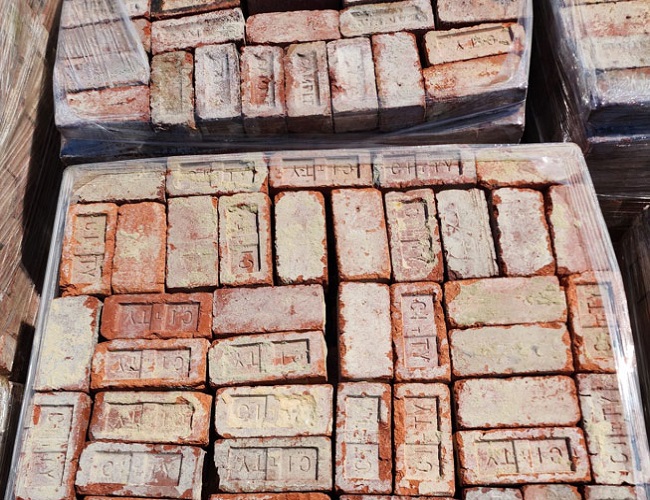
Bricks have to come off a demolition site by hand, because machinery crushes them. Then the mortar, paint stains and dust have to come off, also by hand. Then someone has to check every brick for contamination, wear and cracks, and reject what fails. Then it gets sorted and stacked on pallets.
Do all of that, and you have material that goes straight from the pallet into the wall. Skip any of it, and you have handed your bricklayer a cleaning job they will bill you for at trade rates.
That is the real difference between salvaged stock that saves money and salvaged stock that quietly costs more than new. Not the price per brick. The condition it arrives in.
The refurbished bricks Victoria builders order from us are ready to use on delivery. No second clean, no sorting, no picking through a load for the ones worth laying.
Questions to ask any supplier
- Was it dismantled by hand or by machine?
- Has the mortar been removed, or is that still on the buyer?
- Does anyone inspect the batch, and what gets rejected?
- Is it sorted and stacked, or is it a heap?
- Can I come and see it before I commit?
A supplier who answers those quickly and specifically is worth buying from. One who gets vague on the third question is selling you a cleaning job.
When second-hand is the wrong call
Being honest about this matters more than the sales pitch.
If you need exact matching across a large area, salvaged stock will frustrate you. The variation is the product. Fighting it means paying someone to sort out the exact quality you came for.
If your timeline has no give in it, that is also a risk. Salvaged supply depends on what has come off sites recently, not on a factory run. Rare material especially. Plan around it or buy new.
And if the price is dramatically below everything else, treat that as information rather than luck. Somebody has skipped a step, and it is usually the cleaning or the inspection.
So, worth it?
For brick, yes, and the argument is not really about sustainability even though the environmental case is real. Reusing material means no new clay dug up, no firing energy spent, and less construction waste going to landfill. All true, all worth having.
But the reason it holds up commercially is simpler. You are buying material that has already proved it lasts, in a look you cannot buy new, at a rate that leaves budget for the rest of the job. The environmental part is a bonus, not the justification.
The catch is that all of that depends entirely on who processed it. Buy from a yard that does the work properly, and second-hand brick is one of the better decisions available on a build. Buy the cheapest load you can find online, and you will spend the difference twice over.
Come and have a look
We hold fire brick alongside clinker, cream, Hawthorn, masonry, mud, paving, solid clay, vent and wirecut. Everything gets salvaged by hand, cleaned, checked and stacked before it goes on sale.
The yard is at 33-35 Brooklyn Court, Campbellfield, open Monday to Friday, 9 am to 5 pm. Pick a few up, look at the faces, and ask what came off which site.
Call 1300 893 366 or get a free quote.