
A build usually does not look cheap because the budget was small. It looks cheap because the money went to the wrong places. Somebody spent up on things nobody will ever see and then ran out of room by the time they got to the front path.
That is the whole problem in one sentence. Fix the order and the same budget buys a completely different-looking house.
Nobody sees your frame
Think about what a visitor actually registers when they arrive. The driveway. The path to the door. The wall they walk past. The courtyard out the back. Maybe the fire pit if they stay for dinner.
They never see the structure. They never see the bracing, the sarking, the sixteen decisions your builder made behind the plaster that ate a third of your budget. Those decisions matter enormously for the house lasting fifty years. They matter not at all for how it looks.
So the rule is simple, even if applying it is not. Save on the parts that are hidden and durable. Spend on the parts that get looked at and touched.
Why salvaged brick changes the maths
New brick gives you consistency. Every unit the same size, same colour, same face. On a big wall, that reads as clean. On a garden path it reads as a display home from 2018.
Reclaimed brick gives you the opposite. Size imperfections, natural colour variation, weathered texture across the face. That variation is the thing people pay landscape designers to fake with staining and tumbling, and you get it as a by-product of the brick having already lived somewhere for decades.
The refurbished bricks Melbourne renovators buy from us come out of old factories, houses, heritage properties and chimneys. Every one carries a bit of where it came from.
Paving is where this pays off hardest
If you only make one swap on the whole job, make it the paving.
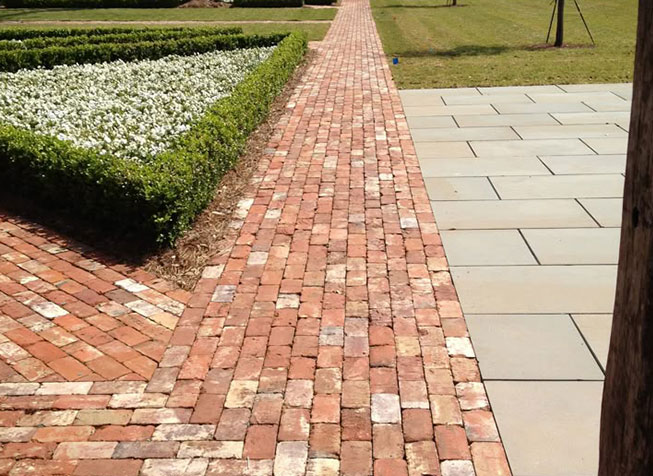
Recycled paving bricks are flat, hard and built to take rough treatment. Strong enough for a driveway and the weight of a car on it. Slip-resistant enough for a walkway that gets wet. Weather, moisture and fade-resistant, which matters more in Melbourne than most people allow for when they are choosing on looks alone.
They come in brown, red, terracotta and orange, usually with some fading through the batch. On a front path, that subtle unevenness is the entire effect. A brand new paver announces exactly how old it is. A reclaimed one makes a two-year-old house look like it has been there since the forties.
They are also easy to work with. They cut and stack using ordinary methods, so you are not paying a premium in labour to make a saving in materials.
The honest bit about cost
Recycled is not automatically cheaper, and anyone who tells you it always is has not watched the process.
Bricks get dismantled by hand. Heavy machinery crushes them, so it is people on a site pulling them off one at a time. Then the mortar and paint come off by hand as well. Then an inspection team goes through looking for excessive wear, and only after that do the bricks get cleaned, stacked and transported.
That is a lot of labour, and it sits in the price. What you are buying is not a bargain-bin discount. It is material with character and proven durability at a sensible rate, from bricks that have already survived fifty or a hundred years of weather.
Which is also why you should be suspicious of very cheap salvaged brick. If the price looks too good, ask whether the mortar has actually been removed and whether anyone inspected the batch. Uncleaned rubble is cheap for a reason, and your bricklayer will charge you the difference back in hours.
Three places worth the spend
The approach. Driveway and front path. This is the first and last thing anybody sees; it gets the most use, and it is the cheapest square metreage on the property to make interesting.
One wall that carries the room. An accent wall inside, a low retaining wall in the garden, a run of planter boxes along a fence. One well-built brick surface does more for a space than four rooms of expensive paint.
The fire. BBQs and fire pits handle heat well in brick, and an outdoor fire is the feature people gather around rather than just look at. It earns its cost in use.
Where to save without anyone noticing
Order the whole job at once. Salvaged stock varies by batch, and matching later is harder than getting it right on the first order.
Let the colour variation do the work instead of paying for uniformity. Mixed textures and colours across a patio are a feature, not a compromise, and asking for a perfectly matched batch of reclaimed brick means paying for sorting labour to remove the exact thing you came for.
Reuse across the site. Leftovers from a driveway become edging, a planter box or a step. Order with a bit of headroom and put the offcuts to work rather than buying a second small load later at a worse rate.
And tell your bricklayer before they quote that the sizes vary by origin and the weights vary by thickness. That is normal for reclaimed brick. A layer who finds out on the morning of the job will price the surprise into the invoice.
Look before you buy
Photographs are useless for this. Colour reads differently in daylight, the texture does not come through on a screen, and the variation across a batch is impossible to judge from a listing image.
Come to the yard, pick a few up, put them next to each other. Bring your builder if you can.
We carry paving alongside clinker, cream, Hawthorn, fire, masonry, mud, solid clay, vent and wirecut brick. The yard is at 33-35 Brooklyn Court, Campbellfield, open Monday to Friday, 9 am to 5 pm.
Call 1300 893 366 or get a free quote with your square metreage, and we will tell you what is in stock this week.